-
MyChart
Log in to our secure, personalized website to manage your care (formerly myMDAnderson).
-
Request an Appointment
If you are ready to make an appointment, select a button on the right. If you have questions about UT MD Anderson’s appointment process, our information page may be the best place to start.
Appointment Information - Donate Today

Project TEAM

Using Nicotine-Replacement and Other Therapies
American movies often glamorize the singular efforts of their heroes or heroines. Early audiences were thrilled to see tall handsome heroes in Westerns face the bad guys alone at high noon on Main Street and bring them to justice. Later audiences cried when strong-willed women overcame outdated standards to achieve personal, social, or economic success. It's no wonder, then, that we often hear people express the belief that overcoming another hardship—beating a tobacco habit—is something to be accomplished alone. Whether this springs from culture or from unfamiliarity with therapeutic options, the truth is that no one need go unarmed or unaccompanied into battle with nicotine addiction.
Physicians, pharmacists, and counselors are professionals who can join smokers in their fight to overcome a tobacco habit. They bring with them nicotine replacement therapies in an array of forms to help tobacco users meet the challenge, whether it is a teenager who needs a therapy that is not evident to peers or an adult who needs the oral stimulation provided by gum or lozenges. They also have drugs that can ameliorate the ups and downs of nicotine withdrawal. Professionals can tailor the therapy to meet the patient's needs (for a scenario, click here).
No "Right" Way To Quit
Patients can choose an individual course. They can choose a pharmacologic aid to help or they can choose nonpharmacologic methods: stopping cold turkey, tapering use, undergoing individual psychological therapy or participating in group therapy, or reading self-help materials and following the advice. Most effective—that is, the method most likely to help a person quit smoking and sustain abstinence— is using a combination of these therapies. Because a combination of a nicotine replacement therapy and an antidepressant is dramatically more effective than a single therapy alone, the government's report on treating tobacco dependence urges that "all patients attempting to quit should be encouraged to use effective pharmacotherapies for cessation except in the presence of special circumstances."
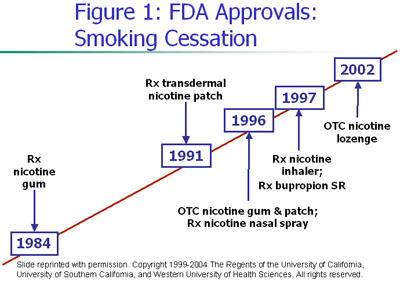
First-line therapies for smoking cessation are (a) nicotine replacement therapy, which is available in many forms (gum, patches, lozenges, nasal spray, and an oral inhaler), and (b) a psychotropic drug (bupropion/Zyban). Nicotine gum first became available about two decades ago, but lozenges only emerged in 2002 (Fig. 1).
|
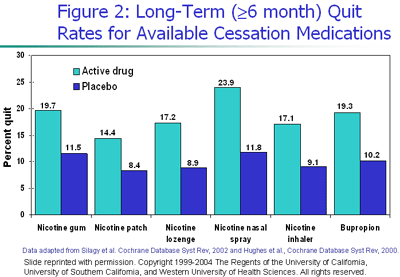
Second-line pharmacologic therapies, which have proven efficacy in helping patients to quit but do not have an FDA indication for smoking cessation and have undesirable side effects compared to first-line agents, include clonidine (Catapres) and nortriptyline (Pamelor;Aventyl), both available by oral administration. Clonidine also comes in a transdermal patch. With these therapies, the estimated odds of quitting relative to placebo range from 1.7 (nicotine patch and gum) to 2.7 (nasal spray) (Fig. 2).
|
Page 1 of 6 next >>